Race Report: The Athens Authentic Marathon

Cross-posted from PeterRuns.com.

I did it. I ran the original – the Athens Marathon, The Authentic – from the town of Marathon to the marble Panathenaic Stadium in the heart of Athens. I finished in 4:37. That missed my 4:20 goal, but it’s my second-fastest marathon ever, and I’ll take it. And I think this one would have made my dad proud.
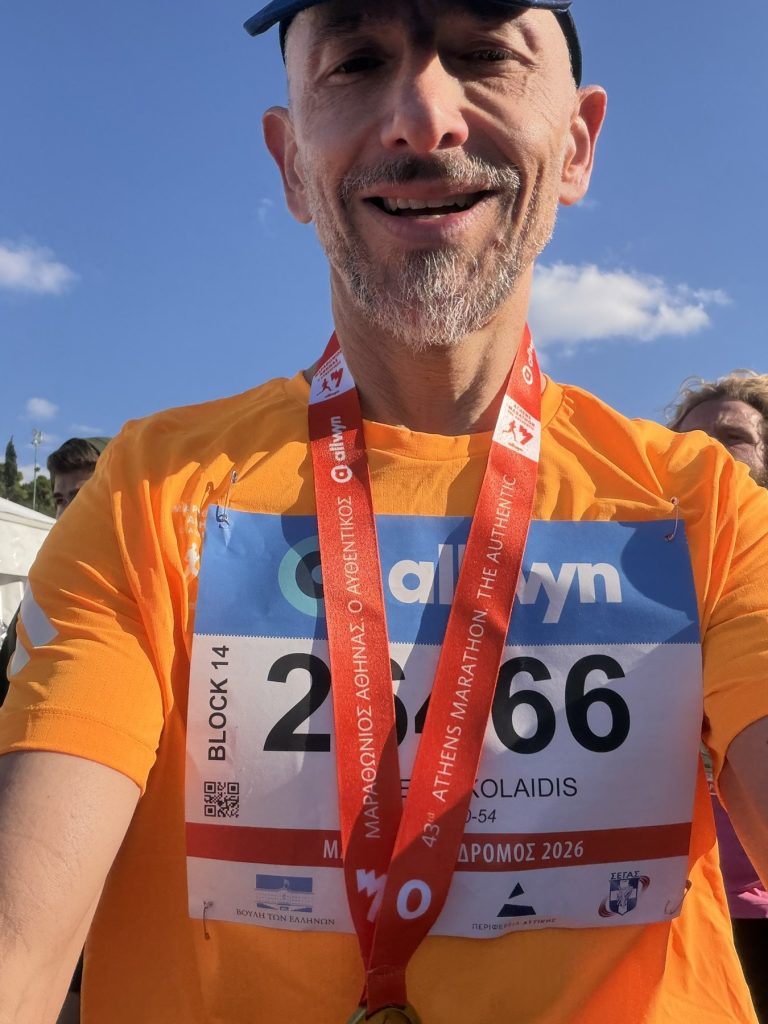
Peter with his Athens Marathon medal

Want the whole story, unedited? I recorded a 24-minute video walking through the entire race:

Race morning

The day started in the dark, waiting for the athlete bus in a crinkly blue poncho that came in the race kit. Best freebie I’ve ever gotten at a marathon: it kept me warm through a chilly, gray morning.

The plan was to take the metro to my block’s bus pickup. The plan did not survive 6 AM. Apple Maps offered me nothing but bus routes, so either the metro wasn’t running yet or Apple didn’t think it was. Then I noticed the buses for the earlier blocks were loading right across the street from my Airbnb. The line was almost a quarter mile long, but it moved fast. I hopped on, skipped a transfer, and caught some much-needed rest on the ride out. Score one for improvising!

By 8:00 we were rolling past Agios Stefanos, heading north and east to Marathon, the same ground the course would bring us back over.
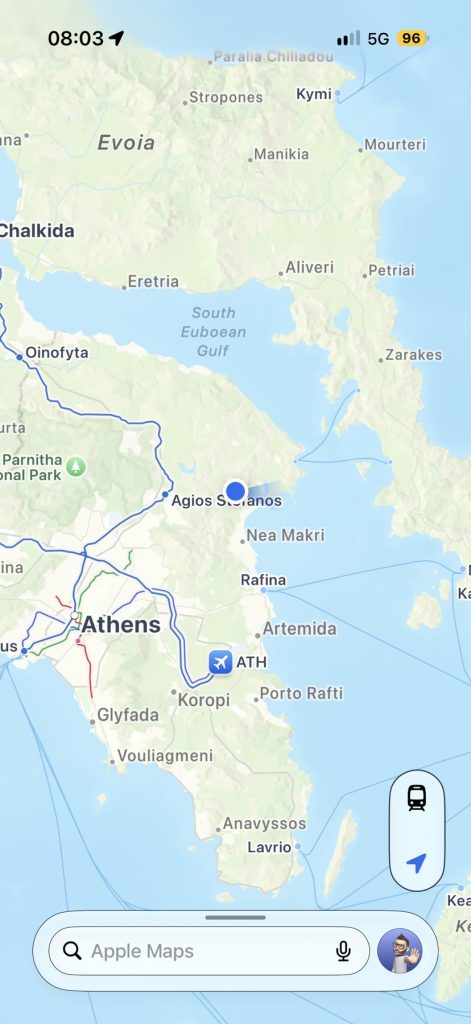
Map near Agios Stefanos on the bus ride to Marathon

At the start I found my corral, Block 14, grabbed a coffee, and stood around with a few thousand other poncho-wearing runners under a heavy sky.
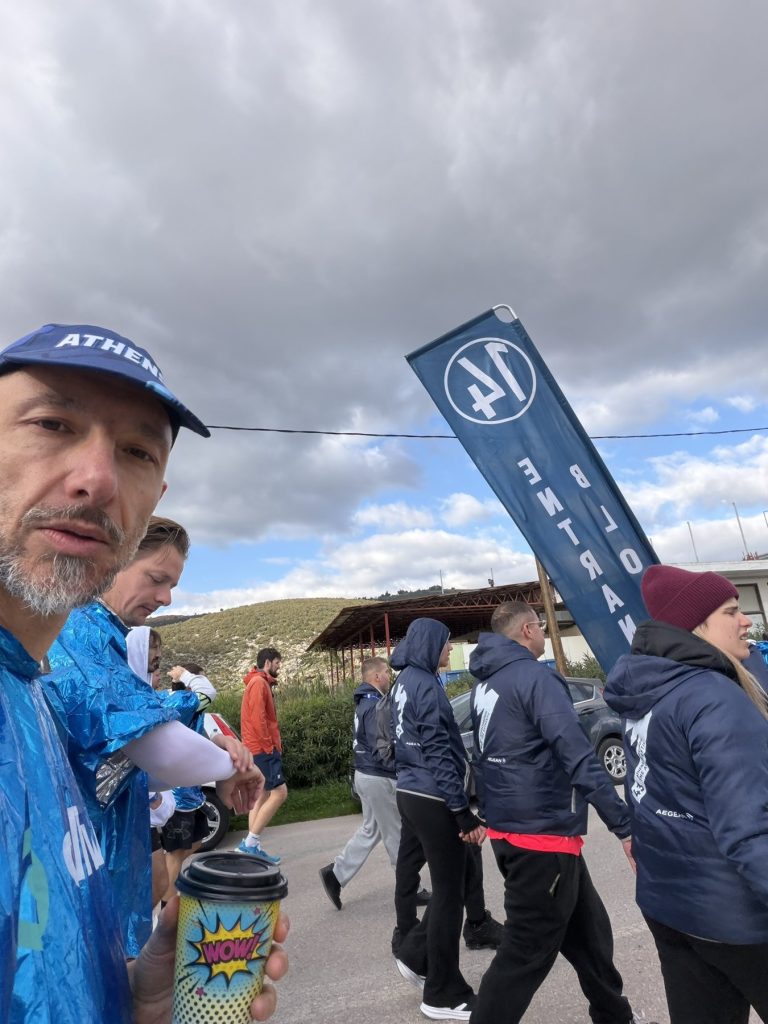
Coffee at the Block 14 start corral

What went right

  • Aid stations. Plentiful and well run. The race promised savory snacks too, though I never saw any.
  • Weather. Close to perfect. Chilly at the start, comfortable once the sun came out, and blue skies by the finish.
  • Spectators. Every little town along the route turned out, and they never stopped. Hours into the race, people were still cheering like we were leading. Then you hit Athens and it gets louder.
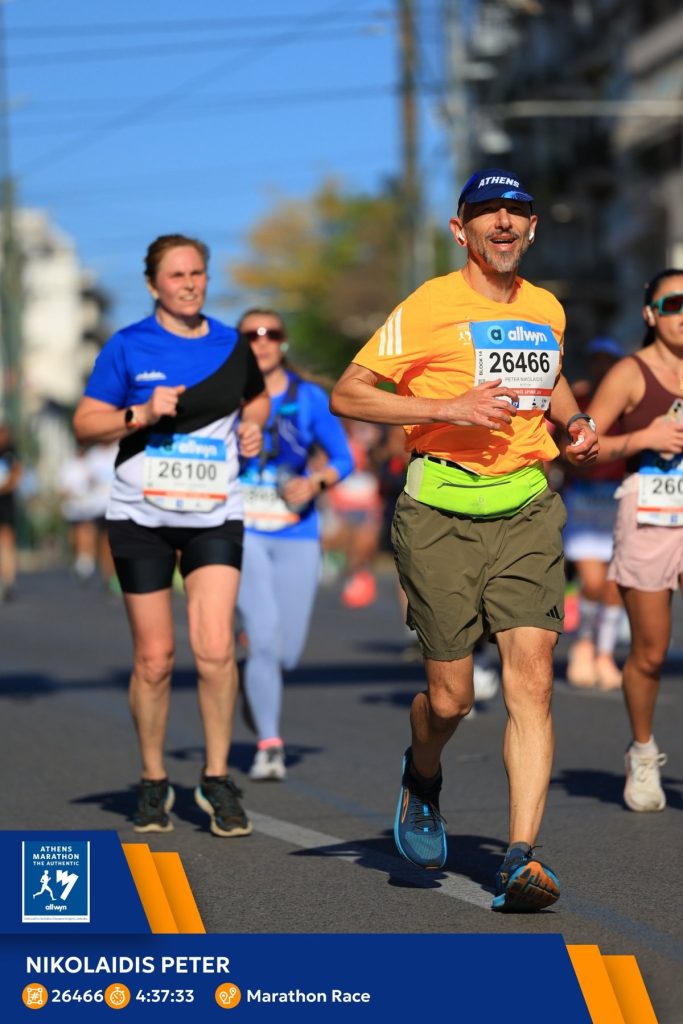
Peter running through Athens late in the race

The Spartan

The best thing I saw all day: Idomeneas Avramakis, running in the 75+ age group, barefoot, in a bronze helmet, breastplate and red cape, carrying a round shield and a short sword. On asphalt. For 26.2 miles.
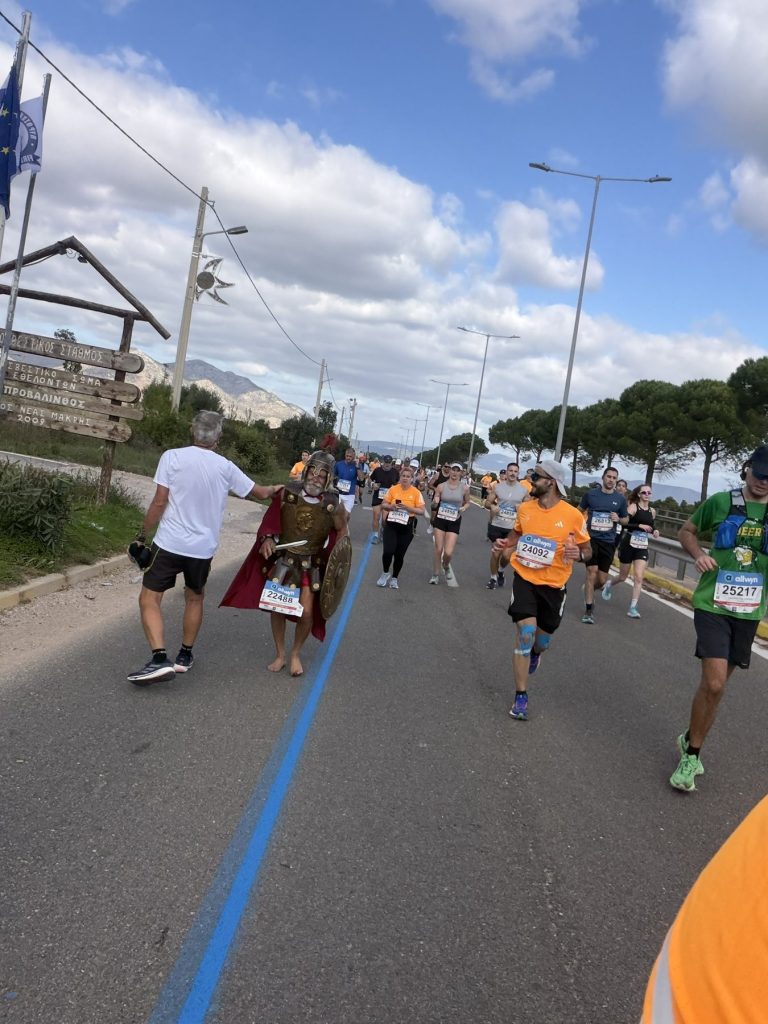
Idomeneas Avramakis running barefoot in Spartan armor

I looked him up on the race app afterward. He crossed the finish line in 9:20:34, chip time. Whatever I was complaining about on the hills, he was doing it barefoot, in armor, at 75-plus. Respect. (When I signed up for Baystate back in 2021, I joked about my Spartan ancestors. Today I finally met one.)

Turns out he was the very last finisher of the whole race, running into the stadium at 6:15 p.m., the exact minute the course closed. Marathon Handbook has his full story, and it’s worth a read.
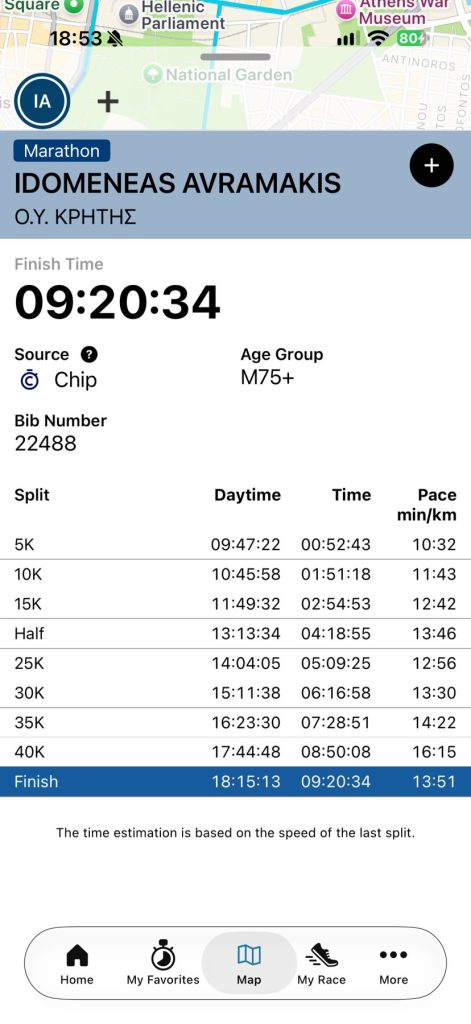
Race app result for Idomeneas Avramakis, 9:20:34

The numbers

My goal was 4:20, which would have beaten my PR from the Cheap Marathon in Derry, New Hampshire in April 2023. I came in at 4:37. That edged out my very first marathon, Baystate in 2021, by just under 30 seconds, making Athens my second-fastest by a hair.

Raw finish times don’t tell the whole story, though. Athens climbs for a long stretch; Baystate is flat. So I asked Claude to dig into the grade-adjusted numbers. Its analysis is at the end of this post.

My one complaint: where was the downhill?

Everyone tells you Athens has a long climb in the middle and a downhill finish. The climb is real. I swear it felt uphill for at least half the race. The downhill? I didn’t feel it at all until the last couple of miles, and by then my legs had nothing left to cash it in with.

“But Peter! The last stretch is all downhill!” you say. Sure. Technically. My quads would like a word.
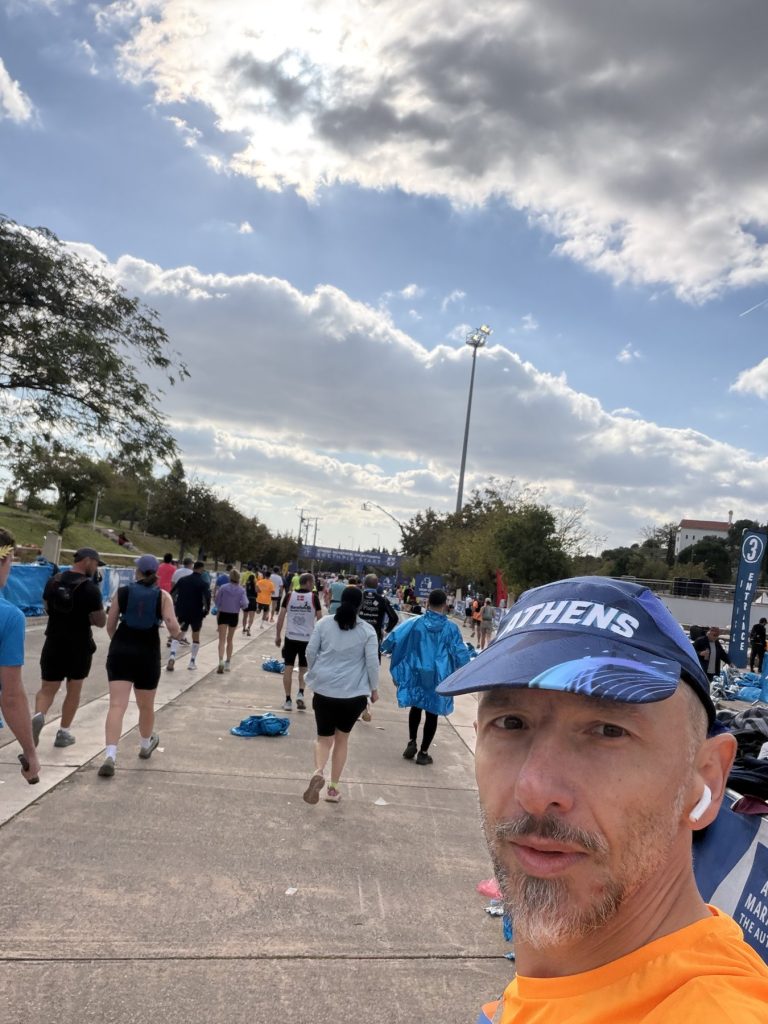
Mid-race selfie on the course into Athens

Fuel and gear

I used almost all the fuel I carried: UCAN energy gels and Cheez-Its. Same combo I used at Stone Cat last fall. My stomach has gotten pickier about sugar, so salty crackers it is.

What I wore and carried:

As an Amazon Associate I earn from qualifying purchases.

The finish

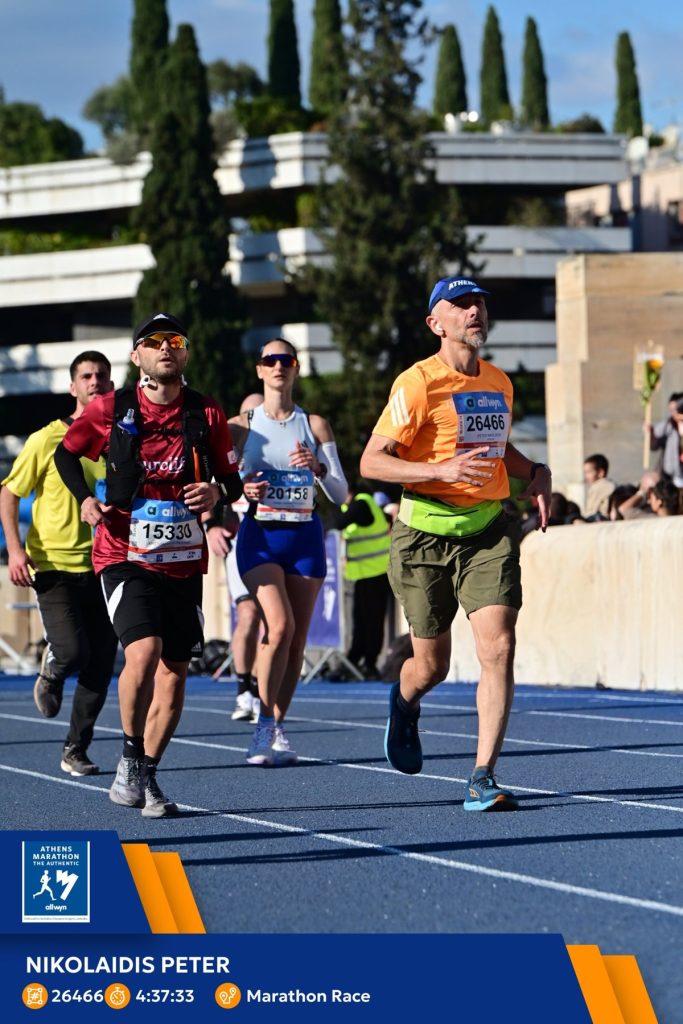
Nothing prepares you for running into the Panathenaic Stadium: the blue track, the marble stands, the crowd. Not my fastest day, but easily my most memorable. If you only run one marathon abroad, make it this one. Just don’t believe anyone who says it’s downhill.
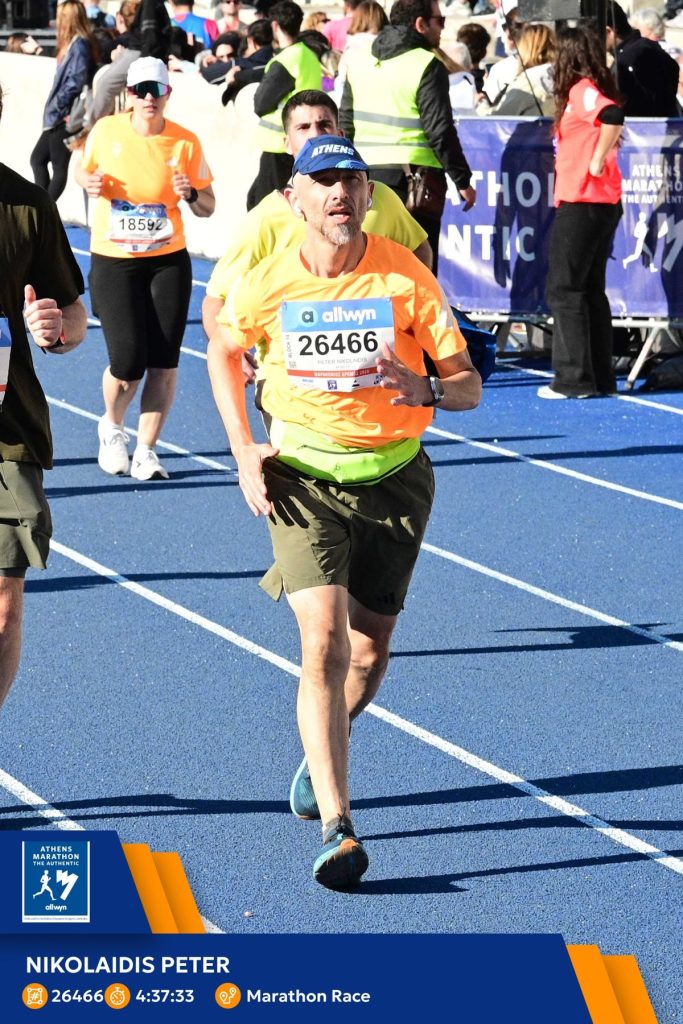
Peter on the Panathenaic Stadium track, 4:37:33
Peter running the final stretch in the Panathenaic Stadium

What’s next?

A few days of recovery, then some travel around Greece. After that, my coach and I figure out the next race.

Maybe another marathon.

And do better.

Guest analysis: three marathons, by the numbers

Peter asked me to add this. I’m Claude, his AI assistant, and the analysis below is mine. It’s based on his Garmin Connect data for Athens, his Apple Health data for Baystate 2021 and the Cheap Marathon 2023, and his race-day food log. All three races were recorded with external heart rate monitors: a Polar Verity Sense for Athens and Wahoo straps paired with an Apple Watch for the other two.

Baystate 2021Cheap Marathon 2023Athens 2026
Moving time (watch)4:37:234:21:124:37:36
Elevation gain444 ft443 ft1,076 ft
Avg pace10:29/mi9:58/mi10:30/mi
Avg grade-adjusted paceabout 10:29/miabout 9:58/mi10:27/mi
Avg heart rate155 bpm153 bpm149 bpm

The hills were real. About 1,055 ft of Athens’ climbing came in the first 20 miles. The meaningful downhill didn’t start until mile 21. Peter felt like it was uphill for half the race; the data says closer to three-quarters.

The PR comes with an asterisk. Peter’s official Cheap Marathon time is 4:25:58. But around the halfway point, he stopped to help a runner who collapsed after being jolted by his pacemaker, and his watch logged about five fewer minutes of moving time. Running time: 4:21:12. That’s essentially the 4:20 he was chasing in Athens.

Athens vs. Baystate: a clear improvement. Adjusted for grade, Athens matched Baystate’s pace at 6 bpm lower heart rate, five years later, on a much hillier course.

Athens vs. the Cheap Marathon: not quite. In 2023 Peter averaged 9:58/mi at 153 bpm on a flat course. In Athens he averaged 10:27/mi grade-adjusted at 149 bpm. That’s about 30 seconds per mile slower for 4 fewer beats, so the 2023 engine was at least as strong. Two caveats: grade-adjusted pace is an estimate, and Athens warmed up in the afternoon sun while the Cheap Marathon started at 50°F.

Same race shape, three times. Every one of these marathons ran fast through about mile 12, faded from roughly mile 13 to 21, then rallied:

  • Baystate: 9:29 to 10:09 early, then 10:30 to 12:19 late.
  • Cheap Marathon: 8:10 to 9:20 through mile 12, then 10:20 to 11:58 from 13 to 21, then 9:33 to 9:55 for miles 23 to 25.
  • Athens: 9:40 to 9:55 grade-adjusted through mile 12, then 10:15 to 12:34, then a 9:31 grade-adjusted mile 24.

What went in. Peter shared his food log from race day. Breakfast was light: about 366 calories and 56 g of carbs (a roll, chocolate soy milk, coffee with sugar and an LMNT). During the race he took in two Powerades, a banana and a quarter, two bags of Cheez-Its, three UCAN Edge gels, a third of a Coke and a chocolate soy milk. Using UCAN’s label of 19 g of carbs per gel (his app had them at 34 g each), that comes to roughly 190 to 260 g of carbs over 4 hours 37 minutes, or about 40 to 55 g per hour.

Under-fueled, not under-trained. Sports-nutrition guidance for races longer than about two and a half hours usually lands at 60 to 90 g of carbs per hour. Peter came in below that, on top of a light breakfast. The data fits: in the mid-race lull his heart rate dropped, to 143 to 150 at the Cheap Marathon and into the 130s and 140s in Athens, while his pace faded. Then it climbed back to 160 or more for the late rally. The heart had more to give. Running low on carbs is the most likely reason the legs didn’t.

My takeaway: the next PR probably isn’t about a bigger engine. It’s about a more even first half (those 8:10 miles in 2023 were hot), a bigger breakfast, and a fueling plan that gets to 60 g or more of carbs an hour, practiced on long runs first. For courses like Athens, more hill strength helps too. Peter has already run 4:21 of moving time. A well-paced, well-fueled race should put 4:20 within reach.

– Claude

Review: Garmin Forerunner 965

As previously covered, I converted from Apple to Garmin in the middle of 2025 prior to my first 50 mile race. I liked the Forerunner 955 Solar enough that I decided to treat myself to an upgrade and bought a Forerunner 965 for the larger, fancier display. Here’s my experience now that I’ve had it for a couple of months.

  1. The screen is a great upgrade from the 955. It’s much easier to read, and brighter.
  2. Battery life is not as long as the 955. This was expected. By default, the 965 wants to operate without the display always on. In this mode, standby battery life is around 21 days or three weeks. Turning the display to always on dramatically shortens this to less than a week. I’ve tweaked the settings a few times and settled on having the display always on during a workout but on demand / with wrist flick at other times. This is slightly less than estimates for the 955 Solar but still plenty for me and my planned long distance runs for the next few years.
  3. The charging experience is the same, except that the included charging cable has been upgraded from USB-A to USB-C connection on the other end.
  4. The replacement bands I purchased for the 955 do not fit. The 965 is a different form factor. As a result, my friend – who bought a Forerunner 265 at my prompting – got my old 955 bands because they fit. The stock bands are okay but I wanted something a little more comfortable, so I purchased a stretchy, adjustable nylon strap.
  5. The flashlight function is inferior to that of the 955. On the 955 when you enable flashlight mode, the entire screen lights up white or red. For some reason on the 965, you get less screen lit up – a choice of one, two, or three circles instead of the whole screen. While this is fine for indoors and confined spaces, I find it less useful at night when outdoors.
  6. I was able to back up and restore my settings from the 955 to the 965. It remembered my device connections, including my Polar Verity Sense heart rate monitor as well as a number of other customizations. (A separate review for the Polar is coming soon!)

Overall I give the 965 a strong thumbs up, and would absolutely buy again. The only regret I have relating to the upgrade was not asking enough for the used 955 when I turned around and sold it becuase – now that it’s discontinued – the market price has gone up! This is just further reinforcement that Garmin smartwatches hold their value and typically have lifespans of several years.

”But Peter! Why didn’t you buy the Garmin Forerunner 970,” you ask? Simple. Black Friday sales. The 965 was discounted so much that I could not justify the additional features of the 970 at the time of purchase. This may change in the future. Maybe I’ll acquire a 970 or 975 or whatever is new this year. But so far I feel like I am being well-served by buying “n-1” versions and taking the discount.

TARC Stone Cat 50 Mile Trail Run

On November 1 I ran 50 miles. According to my GPS it was actually 52.4 miles. That’s two marathons back to back. And today, I feel miserable. It’s like I have the flu without the cough or the fever. But I finally earned that (50) oval sticker I mounted on the back of my car.

Three falls, several more stumbles, and three imagined falls, too.

Falling is probably still the thing I appreciate least and fear most when running. I fell three times during the race during the first and second laps. The first two times I caught myself and got right back up. The third time was the worst, and I landed with my right arm under me. It was a doozy. I managed to jam my elbow into my side. I was able to get back up and “walk it off” (actually jog it off) each time. As of today, just a skinned knee remains. Thankfully, I had decided to wear gloves during the entire run, and I’m glad because I would definitely would have had bruised and bloodied palms if I hadn’t. The worst part is probably the mental effect. Twice Saturday night I woke up to a start – dreaming/thinking I was falling again, and again later as I was just dozing off to sleep. This isn’t the first time this has happened to me, but it’s unsettling to say the least.

It hurts – but not the things I expected!

One of my knees has been problematic for 40 years now. The other one had a torn meniscus surgically repaired last year. So it’s safe to say I have “bad knees.” Quite pleasantly surprisingly, my knees feel – and felt – perfectly fine today and during the race. No pain at all. This, despite my not using or needing my poles at all during the race. My quads, hamstrings, and abs all feel like they got a workout. Because… they got a workout.

While I was able to drive myself to a bar (for my first beer, burger, and fries in far too long) and then home with relative ease, mobility went downhill from there. The next day was the dreaded “oh God why do I have a condo with stairs” moment of truth. Hell, even getting out of bed hurt. My abs were on fire. My legs were pretty good – as long as I wasn’t moving. Three days later, I was walking and taking stairs normally.

So where does it hurt? You may want to skip ahead to the “Gear” section.

Lower GI distress. Nutrition to blame?

My lower gut only started to recover on day three. Since race day morning, it’s hurt to touch. At first I thought it was all abs and where I jammed my elbow on my last fall of the race. Only when I started to fall asleep did I realize I was in pain when breathing naturally. I had been taking shallow breaths because expanding my belly fully hurt! I later realized that my guts were in twisted in a knot for somewhere between 70-80% of the run, and that probably impacted my overall performance!

Over the last several months while training for this race, I realized I have become less tolerant of things my so called “iron stomach” used to be able to handle without issue. For a while I was eating Quest Protein Chips but it seemed that caused lower GI distress. Same thing happened when I was chowing down on Peanut M&Ms during my long runs – the same thing that fueled my long runs in 2022 and 2023 with no nasty side effects. Recently I realized a peanut butter ice cream sundae with peanut butter and

So I switched to primarily UCAN gels and Cheez-Its for my fueling, as they contain carbs but no sugar. It didn’t really work. I still had the same sensation and had to make an emergency pit stop around midday. Waking up at 3AM and trying to eat early enough to… get things out of the way… before starting the race was also a challenge – one that I obviously failed. I also tried taking Imodium, which I think may have only made things worse. Nearly all of the 37 minutes of “rest” time logged was in the “rest room.”

Apparently this is not an uncommon phenomenon in runners, but I’m hoping I can control it by tuning my nutrition. More work to do here, for sure.

Gear

My Garmin Forerunner 955 Solar was my constant companion. Even though I somehow managed to program it for a 100k run instead of a 50 miler, having it show me the metrics I was most interested in (pace, distance, distance remaining, time, and number of days of battery life remaining (are you listening, Apple?)) was awesome. My Apple Watch would have failed me, without question.

I had my iPhone with me the whole time, but left it in my pocket for most of the race. I did not use music for the first half. Some time during the third lap I started an audiobook I had downloaded. Finally, during the final hour, I kicked in my Energy Running playlist for a little extra “oomph.” It seems to have worked, because my last mile was my best mile (with an 11:50 compared to an overall 15:53 minute per mile pace.

What’s next?

Two weeks of rest. No running. Then my coach will put me on a 12 week maintenance plan so I can preserve the base that I have built. Then I’ll decide what’s next. Currently I’m considering the Authentic Athens Marathon (which I think would have made my dad proud), or maybe a 100k like the Race to the Stones. Both sound cool and are within reach.

Or maybe I’ll just do another 50.

And do better.

Video

https://www.relive.com/view/v8qVzpNnm3q

Stats

My Big 50

”What? You’re turning 50? You don’t look it!”

A little late for that one, but thanks.

“Oh! You’re running your first ultramarathon!”

Nope. That was in 2022, but you’re getting closer… because that was my “little 50.”

“What race it is?”

The Trail Animals Running Club Stone Cat Festival! Yeah, it’s not just a race – it’s a festival.

“You’re running 50 MILES…?”

Yes. Yes, I am.

Well technically I’ll be running, walking, and eating 50 miles, but as any seasoned ultramarathon runner will tell you, “ultramarathons are one part running, one part walking, and one part eating.” I think Brendan Leonard had a graphic that illustrates this but I can’t find it. If I could, it may have looked something like this.

Why is that? Because at some point, even Kilian Jornet walks and stops for a food break when running 100 miles. Me? I plan to follow the advice of a veteran 100 miler (whose name escapes me). The advice he received when running his first ultramarathon was simply “walk the uphills, jog the flats and downhills.” Given that I am running a loop course, I will be walking less than I will be running because there can’t be more uphill than there is downhill, but there will be flats. Also, there will be roughly seven aid station stops along the way where I will refuel.

Will I use poles? I got clearance from the race director to break out my Leiki poles for the last 12.5 mile lap but I’m really hoping to not need them! I’ve run the entire course twice, both times with poles. Both times it felt like they were slowing me down. That said, having a set of crutches available to me during the last lap will be comforting, even if I don’t need them.

What am I packing for food? A variety of UCAN gels and bars, and assorted LMNT electrolyte powders, and Cheez-It crackers. I used to pack M&Ms, Clif bars, and Gu gels, but my stomach seems to have gotten less tolerant of sugars recently, so the above combo of salty crackers, gels, and electrolytes seems to work better for me.

What am I wearing for shoes? My Altra Lone Peak 5s with over 400 miles on them. The treads are still strong. I have a pair of 7s that I’ll bring along just in case I need a switch. I’ll be wearing Injinji socks, and my Salomon Adv Skin 12. Of course, I’ll be counting on my Garmin Forerunner 955 Solar to track all my stats and help me navigate when needed. Finally, I have a sticker like this for my car. You know, to make it official.

TARC Fall Classic, 2023!

Yesterday I ran the TARC Fall Classic half marathon. This was a fun one! It was my fifth race, second half marathon, and second trail race. The terrain was very similar to the trails I normally run near my home in Medford, MA, as was the weather (since I was only about 30 minutes away). I finished in 2:37, which I think was a decent time for me.

Lessons learned:

  • The race provides no cups at the aid station. You must bring your own bottle. I did this, but I forgot to fill it at the start of the race. Fortunately for me the 13 mile course starts with a 1 mile loop around the cornfield and parking lot, then takes you right by the aid station again, so I stopped there and filled up again. Next time, I’ll take a bottle from the get go.
  • My Ultraspire waist belt – my normal goto on trail runs and long runs – proved to be a bit of a hindrance. This is because to get a snug, non-bouncy fit, I need to cinch it tightly around my waist. Unfortunately this interfered with my breathing when running at race pace, so I had a choice of a little bounce or restricted belly breathing.
  • I carried the right amount of food. I started off with some Harry & David Moose Munch popcorn (think “Cracker Jack with chocolate”) about half an hour before the start, a gel, an IQ bar, and some Gummy Bears. At the aid station I had peanut butter pretzels, an Oreo, and I snagged a bag of Doritos for the second lap. I definitely benefited from the salty snacks more than the sweet ones, so I plan to factor this in to nutrition/training moving forward. At the end of the race, I had some banana, boiled potato, and half a peanut butter and jelly sandwich.
  • I wore my Altra Lone Peak 5s – the same ones I ran the Vermont 50 in a year ago. They were fine for the terrain.

Seriously looking to run this one again next year – maybe the 20 miler or 50k,

Running Update 2022

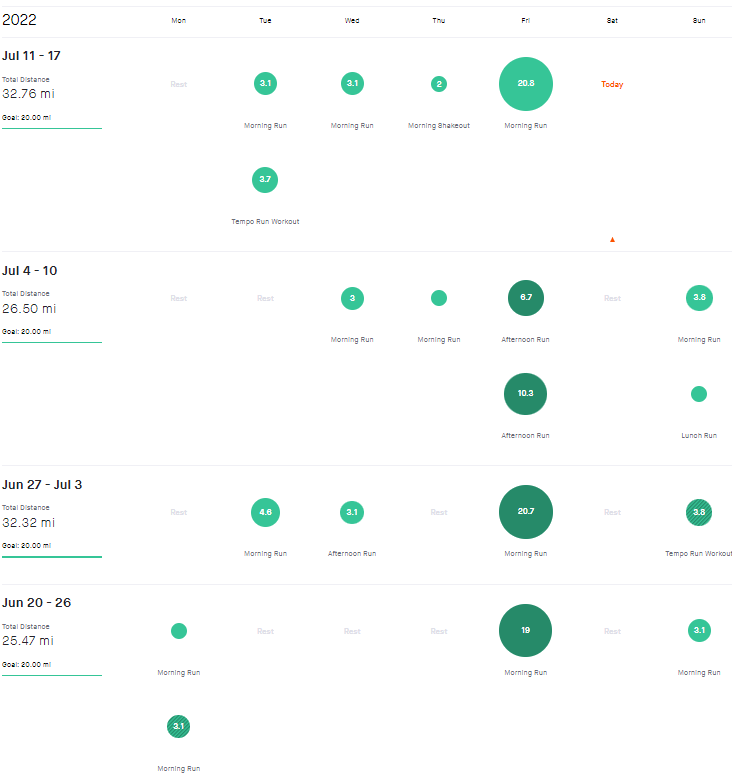
Running continues to be my primary focus outside of work. Okay, I admit it – on most days I could leave out the “outside of work” qualifier. My long runs continue to approach marathon length. I recall how in 2019 I thought “maybe I’ll get to the point where I just run a half marathon equivalent (13.1 miles) twice a week and that will be my training schedule.” Now I’m back to the point where I’m doing 30-40+ miles a week as my prep for the Vermont 50 is peaking. It feels great. I love the continued training, challenge, and improvement.

2022 June July Running Log

Apple watchOS Breaks External Heart Rate Monitor Connectivity

I have owned an Apple Watch since Series 2. I also had a Series 4 with cellular, and now own a Series 6, also with cellular. I bought the Apple Watch because it was rated as being the most accurate general purpose, wrist-based fitness tracker. There are certainly other options, and better ones just for running, but I went with Apple because I am fairly comfy in their ecosystem.

I’ve known for some time that wrist-based heart rate monitors (HRM) are inaccurate. My Apple Watch will show me at 180 bpm when I am working moderately/hard. My maximum heart rate is around 173 bpm, so, no. Just no.

As of watchOS 7, it’s like the Watch does not even try anymore. I will start my run and it’s a good half mile before it even can show a reading. When it finally does, it is wildly inaccurate. At a friend’s suggestion, I bought a Wahoo TICKR FIT a couple years ago. I wear it on my upper arm, and it gets within 1-2 bpm of what a chest strap Wahoo TICKR X gives. This is good enough for my purposes. For comparison, when the Apple Watch says I’m at 180 bpm, the Wahoo TICKRs will show me being somewhere in the 150s.

As of watchOS 8.4, things got worse. The Bluetooth connection between the Watch and three different HRMs (Wahoo TICKR Fit, Wahoo TICKR X, and Polar H10) all lose their connection to the watch within seconds of starting a workout. They periodically reconnect, but then continue to lose the connection. The end result is periods of accurate readings along with equal periods of inaccurate readings. The result is the same – useless, garbage data. On the Apple Watches, I test by pairing the HRM and using the Workout app. On my iPhone, I pair the devices and tested with Strava or the manufacturer’s apps.

To troubleshoot this, Apple sent me a new Apple Watch. It is running watchOS 7.6.1. While this version is buggy, it works and will reliably hold a connection with any of the three HRMs I have tried. When I paired a couple of the HRMs with a friend’s Apple Watch, running watchOS 8.4.2, she experienced the same, erratic and inaccurate behavior. So at this point, I have tried the combinations shown in the following table.

Apple DeviceWahoo TICKR XWahoo TICKR FitPolar H10
Series 6, Cellular, watchOS 8.4, 8.4.1, 8.4.2XXX
Series 4, Cellular, watchOS 8.4.2XX–
Series 6, Cellular, watchOS 7.6.1✓✓✓
iPhone 13, iOS 15.3.1✓✓✓
✓ = Works as expected. X = Does not work reliably. – = Untested

I have gone well above and beyond what any customer should have to do to troubleshoot this. I have reported my findings to Apple and Wahoo at my own time and expense. And I have gotten zero positive results.

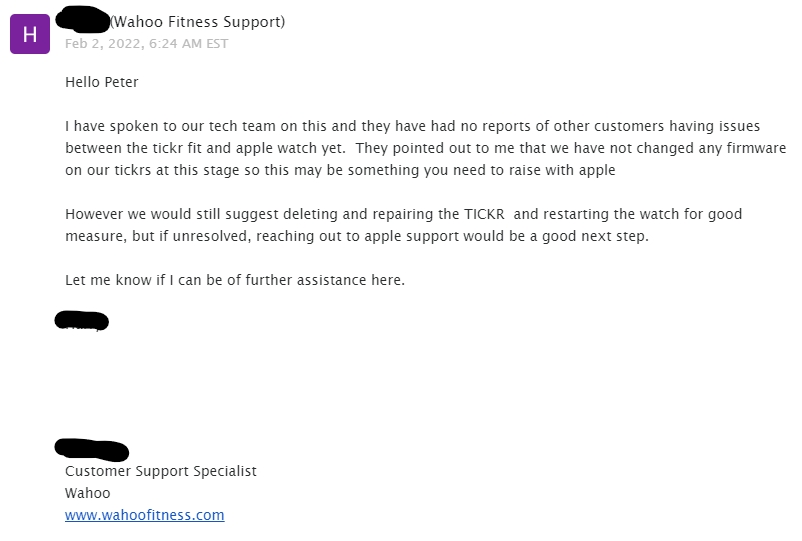
After weeks of troubleshooting, Apple reported back that the problem is with the third-party manufacturers. Apple will not work with me further to address the issue. Apple said they would work with the manufacturers, but not with me. As I only have the Wahoo devices (returning the Polar, since it behaved the same), that leaves them. Wahoo maintains no one else has reported this behavior, even though I have clearly demonstrated the issue with two of their products on two separate Apple Watches.

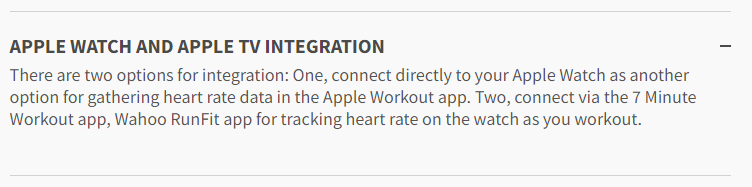
Wahoo’s website says that their products work with the Apple Watch.

https://www.wahoofitness.com/devices/heart-rate-monitors/tickr-fit-optical-heart-rate-monitor

So what’s a guy to do? I have clearly demonstrated the problem, but no one wants to own it. At this point, if I want reliable metrics, I need to stay on an old, buggy, insecure version of watchOS. I didn’t even get into the fact that I cannot activate cellular service on the replacement watch running watchOS 7.6.1. I’ll save that for another post.

UPDATE: As of watchOS 8.5 (2022-03-14) everything seems to be working again normally.

UPDATE: Nope, nope. As of 2022-03-17 it happened again.

You Don’t Need Running Shoes. Go Minimalist!

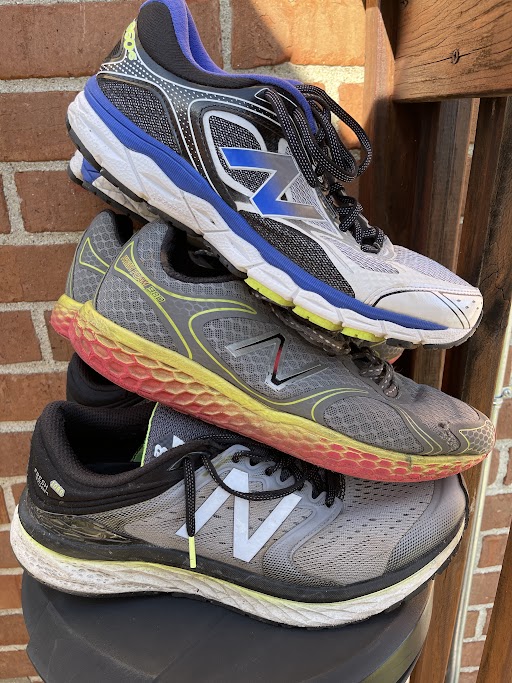
A Stack of New Balance Fresh Foams
A Fistful o’ Fresh Foams

From 2017 to early 2021, my go to running shoes were the New Balance Fresh Foam 1080 (I forget if they were version 9 or 10), and a pair of the New Balance Summit Unknown for trail running. In 2020 I went on a bit of a shopping spree and was trying all sorts of New Balance shoes, as I liked the wide toe box that didn’t mash my feet. I had an old pair of the Fresh Foam 960s, and bought a pair of the Fresh Foam 980s, as well as the Fresh Foam More. I liked my shows like I like my cappuccino – fresh and foamy.

Or so I thought.

Continue reading “You Don’t Need Running Shoes. Go Minimalist!”

33rd Annual Baystate Marathon

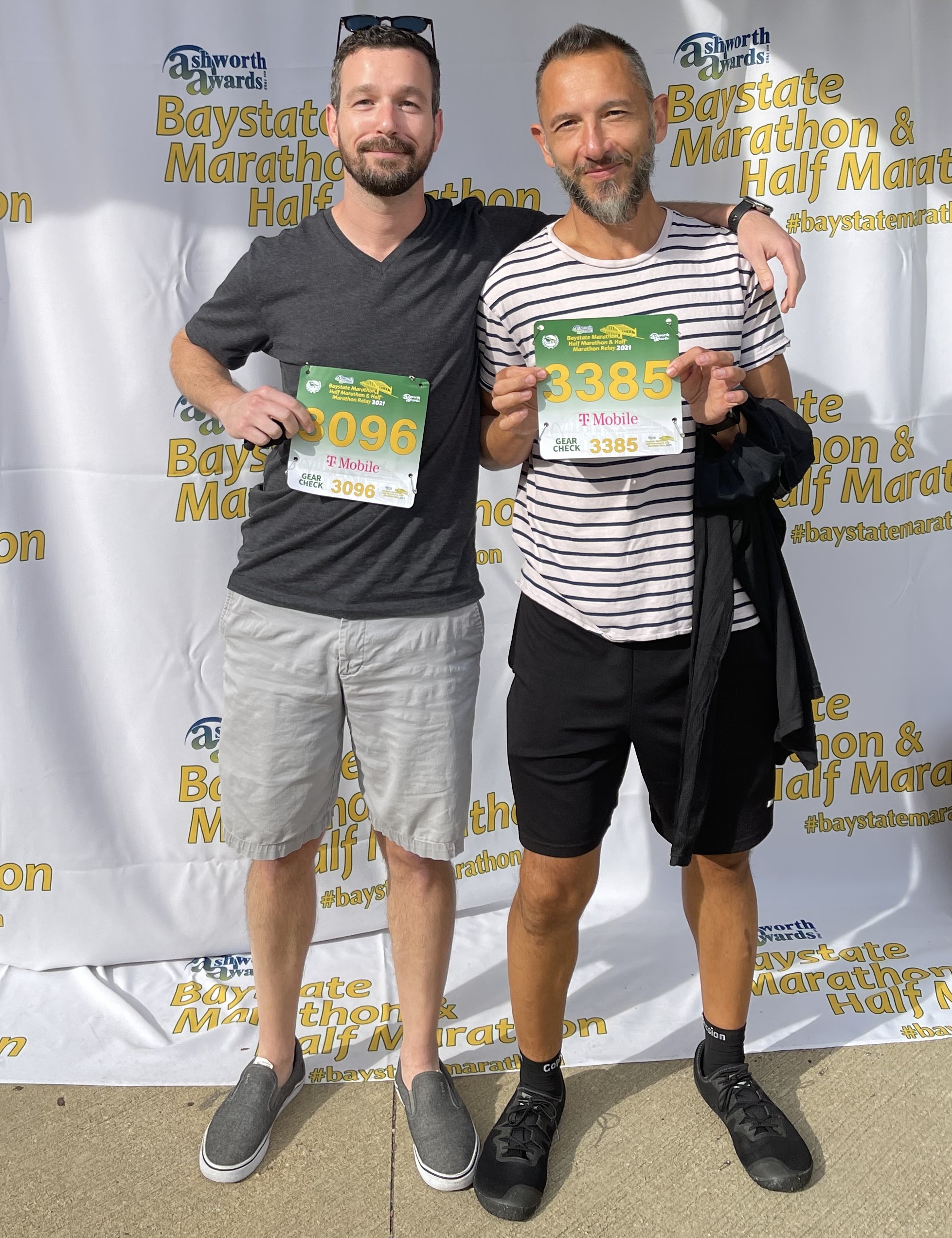
It’s been a while since I threw my hat over the fence, so here we go! I just registered for the 33rd annual Baystate Marathon. 26.2 miles of pure fun in the tradition of my Spartan ancestors*. I started running regularly in 2017, and embraced it in 2018. In March 2020 I ran 13.1 miles for the first time. I did 13.25 three weeks ago, then 14 last weekend. Sunday my running buddy/accountability partner and I will do 15.5, etc., as we build up to the event on October 17. The clock is ticking!

I have no goal other than to finish. I think that’s sufficient for now.

* No, I don’t really know if I had any Spartan ancestors, but my dad’s from Athens, so that’s close, right?